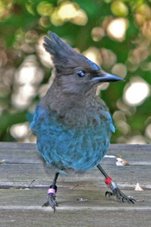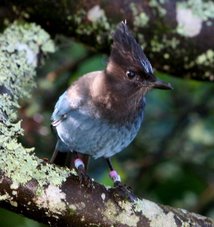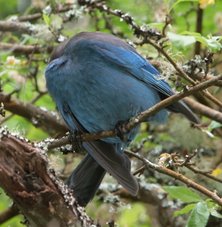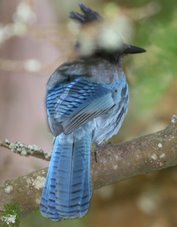
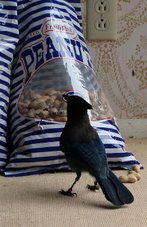
Mr. Go

Mr. Go

THE ORIGIN

June 28, 2007

Several years ago, I noticed a banded Steller's Jay sneaking kibble from our cat's food dish. Having no experience with bird studies, I wondered how and why that particular bird had been captured, and by whom. At that time, (before peanuts) jays were surprise visitors appearing on glorious, sunny days for brief encounters, stealing bits of food, then calling loudly from high branches of redwood trees.

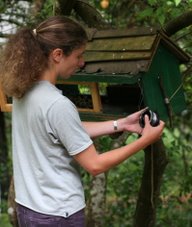
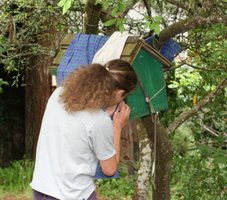
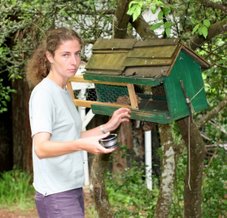
Subsequently, I learned from my friend, Jeff Jacobsen, about Pia and Dr. Jeff Black's study of the "social system and ecological relationships that drive the distribution and dynamics of the local jay population" (Wildlife Department, Humboldt State University--see link below). Pia placed a feeder/trap at eye level outside my family room window where I could see the birds coming and going each day. I looked forward to watching their dazzling-blue plumage, jaunty crests, and trickster manners.

Each of us watching feeders have stories to tell about the relationships, habits, and unique characteristics of individual birds that frequent our places. I hope this blog will allow us to share our observations and images, as well as provide an opportunity to share our delight in these curious, smart, and at times, raucous birds. c.arnold

Red Eye Learns to Read

Red Eye Learns to Read

NOTES

Monday, July 9, 2007

07:03

White, still, sky with a hint of blue

Birds in Order of Appearance:

  1. morlb (Red Eye)
  2. unbanded
  3. mlbrg (Trapper)
  4. mwlblb (Tame Bird)
  5. unbanded with leg mites
  6. unbanded (Rusty Bill)
  7. unbanded (Chopper—formerly Shopper)
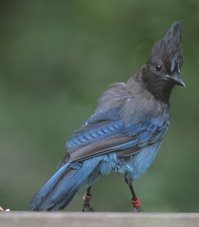
  8. mrgo (Mr. Go)
  9. mlbob (Mrs. Go)
  10. mwbw (Checkers)
  11. mplbp (Princesa)
  12. mwrg (Wringer)
  13. mbow (Bow)
  14. juvenile
  15. mgrr (Droopy)
  16. banded juvenile
Notes:

It is a very quiet jay morning--only three birds so far and a solitary chickadee. I hear sounds of a raven above me, but can’t locate the bird itself. It’s call is a two syllable, “honk, honk,” goose-like, rather than the more familiar “squa, squa.” There is another call I don’t recognize yet, maybe a hawk of some kind. I saw the silhouette of a large, narrow bird with long, pointy-tipped wings, dark against the window of white sky. I’ll see if I can find it in the Sibley’s Guide. Based on evidence and bird behavior, there are predators in the neighborhood.


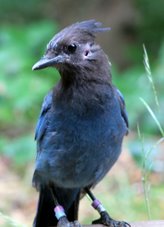
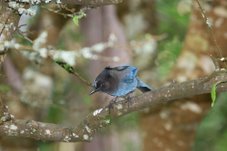
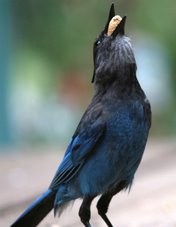
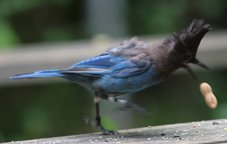
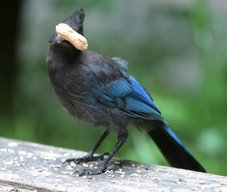
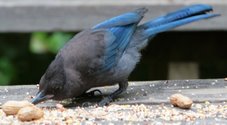
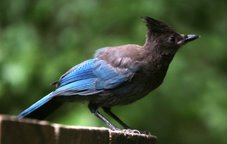
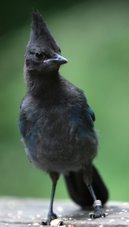
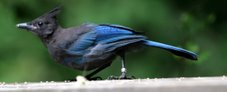
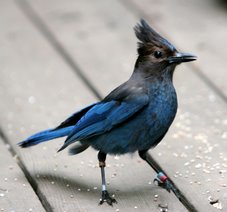
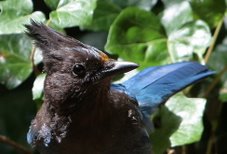
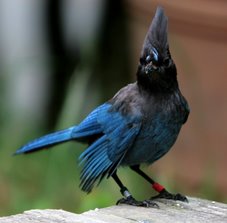
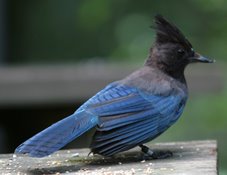
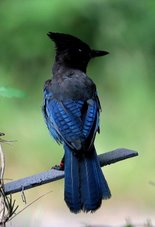
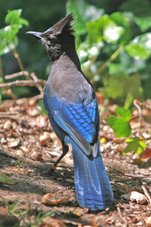
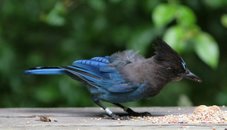
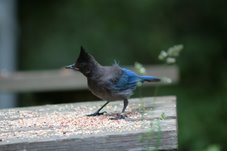
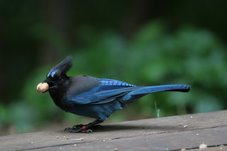
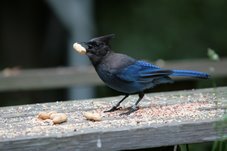
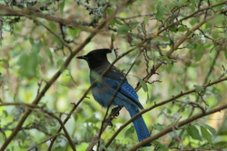
Mr. and Mrs. Go feed more on seeds than peanuts. They are not intent, like the others, on clearing out the feeder of peanuts. They are an attractive couple perched next to each other. He stands tall, alert and erect, emitting an occasional, “chip” accompanied by a display of one wing flap. His feathers are sleek; he looks strong and capable. She, on the other hand, squats low, plumps her feathers out as if she is sitting on a nest, often with her left foot tucked underneath her. She is a small, pretty bird; with bright cobalt blue feathers forming the two vertical stripes above her bill. When they are accompanied by a juvenile, they can be heard murmuring to each other using a complicated range of sounds with varied inflections.

Sunday, July 8, 2007

07:20
Still, quiet, white sky

Birds In Order of Appearance:

1. mwbw (Checkers)
2. unbanded
3. mbrg (Trapper)
4. morgo (Mr. Go)
5. morlb (Red Eye)
6. mlbob (Mrs. Go)
7. unbanded (Shopper aka Chopper)
8. mwlblb (Tame Bird)
9. unbanded juvenile
10. lbpmp (Princesa)
11. unbanded (Rusty Bill)
12. mbow (Bow)
13. banded juvenile (Plum)
14. mwrg (Wringer)
15. mwrr (Droopy)

Notes:

Upon rising each morning, I brew my coffee, then feed the birds. I make three to four piles of wild bird seed, a pile of sunflower seeds, and piles of peanuts. Then I sit on the deck and shell a few nuts for myself. There is something satisfying about sharing peanuts with the birds at the beginning of my day. Usually Mr. Go, Tame Bird, Shopper, and more recently, Red Eye, are first to greet me in a flurry of activity. Tame Bird and Red Eye show little fear and will come close to me, daring each other to get the first peanut. Mr. Go stalls until I move farther away, but holds his ground, clearly in charge of who comes and goes here. This morning, Checkers and an unbanded were sitting very quietly in the tree above me, hidden by foliage. There was a lull before the usual crowd joined me.

Shopper is turning into a tyrant. Unlike the other birds who tolerate the youngsters, he frightened a juvenile working to open a peanut. A speed demon with crest slicked back, Chopper is a more suitable moniker. The young bird struggled to first open the nut, not yet able to stabilize it with his toes, nor able to apply the necessary force with its bill. Once he got it open he grabbed the whole peanut and swallowed it whole. Much too big a bite, I watched the bulge of nut travel down his gullet. More careful with the second nut, he pecked it into smaller pieces. He has yet to develop the skill of balancing a nut on a tree branch while gaining access to the other half, so uses the flat platform of the bench.

Saturday, July 7, 2007

06:50

White, still, quiet and wet

Birds Sighted in Order of Arrival:

1. mwlblb (Tame Bird)
2. unbanded juvenile
3. unbanded juvenile
4. banded juvenile
5. mrgo (Mr. Go)
6. unbanded adult (Shopper)
7. mlbob (Mrs. Go)
8. mwrg (Wringer
9. lbpmp (Princesa)
10. mlbrg (Trapper)
11. unbanded (Rusty Bill)
12. mwbw (Checkers)
13. mgrr (Droopy)


Notes:

Shopper is especially aggressive this morning. He is chasing one of the baby jays, here to practice opening peanuts. He swoops fast, through the feeding area, between tree branches reminding me of a bully on the playground. His ratty tail feathers give him an undignified look as he flies. If there were to be a male take-over at this feeder, I bet he would win the contest. He is unlike the others, who show patience and understanding for the young birds. He makes a loud “chooka, chooka, chooka, chook,” temporarily displacing all the birds. Crest plastered back, he crouches low like a jaunty-capped road racer, focused on making good time.

The jays have paths by which they navigate through the trees, branch by branch. They hop and glide through the familiar territory with speed and agility, landing solidly, on spindly legs that belie their strength. They make sharp, familiar turns through networks of leaves. Negotiating openings, they weave their way through levels of space the way we negotiate a river crossing, hopping, then wading, from stone to stone.

Maybe because it’s wet and dewy this morning, the tail feathers of all the birds appear worn and frayed. Molting is progressing at a rapid rate, the new row of feathers, visible beneath the wings when the birds dip their heads down, inches its way posteriorly. I wonder at what point will these new feathers replace the old? I’m saving the loose feathers I find on the ground, a permanent record of the season.

Two juveniles land on the bench, face off, and beg, bill-to-bill. Mr. Go lands; one juvie flies off, and the other begs to the adult male. This is the second time I’ve seen this behavior. It leads me suspect the two are siblings, and possible offspring of Mr. and Mrs. Go.

Again outnumbered by males, the females this morning include plbmp, mlbob, and mgrr. Pia told me yesterday it takes about 16 days for eggs to incubate and 16-20 days for the young to fledge, which means the nesting females could be missing from the feeder for well over a month. She described how the young birds gradually fill the nest until they are too big to fit any longer. They begin flapping their wings and move out onto branches. It is during this period that the fledglings are most exposed and most vulnerable to predators. One pair of adults lost all four of its progeny to ravens at this stage of development; after which, they were forced to begin again, repeating the process of mating, egg-laying, nesting, and feeding their young.

Friday, July 6, 2007

morning hours

Birds Sighted in Order of Appearance:

1. mwlblb
2. mlbrg
3. mlbob
4. one banded juvenile (offspring of mwlblb and molbo)
5. morlb
6. mrog chases morlb
7. mplbp
8. unbanded juvenile
9. mwrg (Droopy’s mate)
10. unbanded male (Shopper)
11. mrgw
12. mbow (Bow)
13. mgrr
14. unbanded—rusty bill

Notes:

Pia came this morning and we watched birds for an hour or so, between 10:00 and 11:00. She reminded me the high-pitched cheep, cheep, cheep is a male-only call, heard when other males are around, often accompanied by the wing-flapping display. We watched the babies come and go, pick up bits of leaves, sticks, old peanut shells, not sure yet what food is and isn’t. They resemble baby giraffes in their stance, positioning themselves with their legs splayed at odd angles. I’ve been putting sunflower seeds out with the mixed seed and peanuts each morning. The babies are practicing opening these small nuts and are surprising adept at grasping a sunflower seed with their toes and tap-tapping into the nut. Their bills lack the strength of the adults though, and they are likely to drop the nut before they reach the meat inside. Their breast feathers are beginning to look less gray and more blue. Pia explained that the distinct bands across the tail are an adult feature and aren’t seen until the juvenile’s first molting a year from now. Last year’s juveniles can be identified by their ragged feathers and indistinct tail bands. The shades and hues of blue appear more varied to me in the juveniles—there is a teal-colored grouping of feathers in the wing, in addition to the bright-blue and gray-blue. Their gape is pink, and they look plump and healthy with full breasts. They come with an adult who keeps a lookout perched above them.

Droopy wing came again for several visits—I hope I got a good photo of her. Her mate, mwrg, “Wringer” is a regular male, along with Tame Bird, Red Eye, Mr. Go and Shopper. They continued today in their hierarchical game of chase, Mr. Go still top bird, though compromised because Tame Bird and Red Eye will come so much closer to me and the house; they are both dare-devils in comparison. He is patient though, and will wait for me to leave and re-establish his dominance at this feeder. Today he was busy chasing the newcomer, morlb (Red Eye) who grows bolder by the day.

Rusty bill made an appearance again today. His pink elbows are a sign of leg mites; I learned from Pia. He darts in and out, but I hope to get a photo of him soon. She (Pia) suspects he may be last year’s juvenile, rather than an aged bird, based on the condition of his tail feathers. We will watch and see if this peculiar marking changes after molting.

Finally, I showed Pia photos of mwbw and rrmo molting. She wondered if they weren’t a pair. I didn’t see either of them today. Other birds missing in action include molbo and mprg—both of whom may be sitting on eggs.

Thursday, July 5, 2007

00:10:00

Birds in Order of Arrival:

1. mwlblb chases morlb
2. mrgo
3. morlb
4. unbanded shopper chases mwlblb
5. mlbob
6. mwbw
7. mgrr
8. mplbp
9. mwrg mgrr’s mate
10. juvenile
11. unbanded (red bill)

Notes:

Last night was July 4th. Relentless boom of fireworks filled the heavy, overcast sky with splashes of light. The acrid residue of smell wafted clear into the house and I thought of the jays, roosting in redwood trees. I briefly heard a “squa, squa,” from a high place—the first I’ve heard a jay call after dusk. Our idea of celebrating must be so frightening for them.

Yet, they were here this morning, ready as ever for a peanut feast, unscathed by the night’s festivities. Once again, the males arrived first. Morlb (Red Eye) is now a regular and was chased by mwlblb (Tame Bird). Unbanded Shopper demonstrated a particularly aggressive move, flapping his wings, hopping towards mwlblb, who yielded and flew to a new perch.

Red Bill landed. He has distinctly orange feathers, the color of a robin’s breast, above his bill. I think of him as an elder. He stands tall, almost regal. The other males fly around him and he remains, undisturbed. Jeff J., after describing Red Eye’s orange feathers to me, said Pia associated orange feathers with age. It’s seems unusual that I haven’t seen a single bird with orange feathers and now have seen two in the last two days. Makes me wonder if the two birds are related, or maybe they're both just old.

My cousin Kristin has asked me if I’ve named the birds. Megan, my daughter, asks the same question. I wobble between writing a narrative--full of personalities, anthropomorphisms and conjectures; and documenting the evidence—those precise observations a scientist would make and later enter in a database. I feel as clumsy as a baby jay, stumbling over a peanut. But, yes, Kristin and Megan, I am naming the birds. It looks like this:


1. mwlblb Tame Bird
2. mrgo Mr. Go
3. morlb Red Eye
4. unbanded shopper Shopper
5. mlbob Mrs. Go
6. mwbw Checkers
7. mgrr Droopy
8. mplbp Princesa (Cesa)
9. mwrg Wringer
10. juvenile unbanded
11. unbanded (red bill) Red Bill

Clearly, this is only a start. There’s mbrg--Trapper, I think, because he spends so much time in the trap, and Bessy for rrmo because she is a mess, a Messy Bessy.

Wednesday, July 4, 2007

07:30

High fog, white sky, warm still

Birds Sighted In Order of Arrival:

1. mrgo
2. plbmp (rattles)
3. unbanded adult
4. banded juvenile
5. morlb (red right eye)
6. mwlblb
7. mlbrg
8. mlbob (rattles)
9. mwbw
10. mbow
11. pbmr (no tail bars?)
12. unbanded chases mwlblb
13. mlbbg?


Other birds sighted:

1. chestnut backed chickadee
2. varied thrush


Comments:

I’m spending a little time each day sitting on the deck with the jays eating peanuts. I notice which birds are willing to come close to me to get a peanut and which pause, roosted above, quiet, alert, waiting for me to move farther away. This is the time I will often hear soft chatty vocalizations. They are my very favorite—because of the variety of sounds and gentleness of tones. They are rich, expressive, and beg to be translated. Could they be subtle warnings that someone is near, or casual approaches to biding time until the coast is clear to feed without intruders? The temptation to anthropomorphize is irresistible and I am aware of a merging jaynesss with humanness-- for the moment, our commonalities more distinct than our differences.
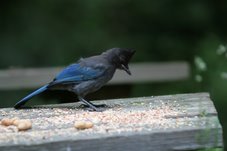
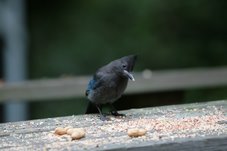
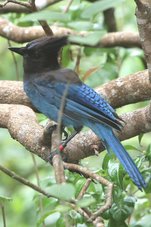
Mwlblb is by far the tamest bird. He may hesitate slightly before approaching me, but then hops, boldly to take a peanut. This is always disconcerting for mrgo, who claims this feeder, but doesn’t have the courage to take charge when I am too near. Today, morlb (red eye) appears more culturally assimilated, taking time to select, eat a peanut now and then, perch, and survey, before caching; however, there are still times when he reverts and becomes unexpectedly skittish, dashing off. He too, is a very tame bird and does not shy away from me.

Tuesday, July 3, 2007

CORRECTION: In my previous notes I used the incorrect nomenclature for blue and black. I’m going to correct the mistake in the “List of Birds” section on the left; however, I cannot edit a posted blog. From now on, I will be using the correct nomenclature.
b = black (formerly bl = black)
lb = light blue (formerly b = blue)

07:15-08:30
High fog, warm, still

Birds Sighted In Order of Arrival:

1. mwlblb male
2. morlb male
3. mrgo male
4. banded juve
5. unbanded juve
6. mwrg male
7. rrmo molting, defined breast
8. unbanded with leg mites
9. lbpmp female
10. mlbob female
11. mpbw female
12. unbanded with burnt-orange bill feathers and swollen, pink elbows
13. unbanded shopper male

COMMENTS:

This morning, I noticed the males in the family came first to the feeder and were followed by the females. Morlb, the newest bird to the feeder, came to and from the east, doing his best to clear out peanuts quickly. No time spent shopping, he swooped in, grabbed one peanut, cached it beyond the eastern border of the driveway, then returned to repeat the procedure in a mad, flurry of greed. This bird has a history that includes visits to the Kokotat and Jeff Jacobsen feeders, along with his mate, mpbw, who appeared for the first time yesterday as well. He has burnished feathers around his right eye and above his bill (loral and supraloral region) that appear orangey-red, a color you might associate with age, or sun bleach. Jeff J. suspects age. The bird’s behavior is foreign; unlike those members of the more familiar group, who linger, choose seed sometimes, peanuts others; take time to crack a nut in a tree and eat it before gathering several, and flying off to cache. Is this reflective of a cultural difference, personality difference, or simply, newness to this place?

Rrwo is back today. Her disheveled appearance is even more distinct now—feathers are rumpled, crisscrossed, springing out from her body in an unruly arrangement that lacks all sense of order. Though small, she looks buxom, rounded breasts forming a gentle line of cleavage down her center. I wonder; is this a seasonal change, an adaptation to nesting that I haven’t noticed before; or a quality unique to this bird? I will watch to see if I notice this attribute in other females.

A new unbanded bird arrived today. He was accompanied by an unbanded juvenile and had the same burnt-orange feathers as morlb, except directly above the upper mandible. He was accompanied by an unbanded juvenile and chased by Mr. Go, who called, “chooka, chooka, chooka, chook.”

Pia Sets the Trap

Pia Sets the Trap
07/24/07

Peaking...

Peaking...
07/24/07

Oops, wrong bird!

Oops, wrong bird!
Demonstrating the "hold"

Try Again

Try Again

Bird in the Bag

Bird in the Bag
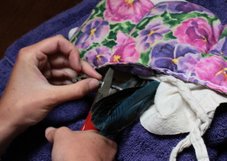
Applying a metal band

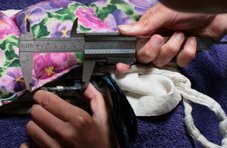
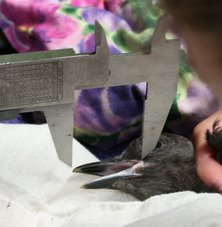
Measuring

Measuring

and more measuring. . . .

and more measuring. . . .

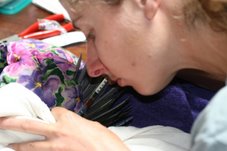
Blood Sampling

Blood Sampling

Jeff J's Work

Jeff J's Work
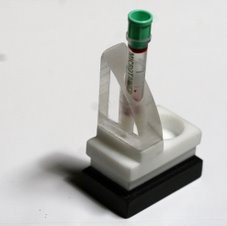
Pia's test tube holder

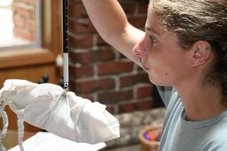
Weighing

Weighing
And then....release

When the sun goes down...

When the sun goes down...

Steller's Jay Taxonomy/Description

Common Name: Steller's Jay

Class: Aves

Order: Passeriformes

Family: Corvidae

Genus: Cyanocitta

Species: Cyanocitta stelleri


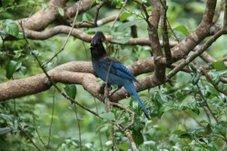
Steller’s jay belongs to the family, Corvidae, in the Avian Order Passeriformes. Passeriformes is the order of perching birds. Corvidae is the jay, magpie and crow family. The Steller's jay's scientific name is Cyanocitta stelleri. The generic name, cyanocitta, means "blue jay". Its specific name, stelleri, named for George W. Steller (1709-1746). Steller was a German zoologist who explored the coastal areas of the northern Pacific Ocean in 1740.

Band Colors

Band Colors
black | white | purple | red | orange
light blue and light blue | green

Note: Light blue is difficult to read. It darkens with age, resembling a green band. (b/w/p/r/o/lb/g)
Bands are read in the following order:
right bottom band
right top band
left bottom band
left top band

Data Collecting

This information was copied from the website of Dr. Jeff Black, Humboldt State University Wildlife Department.

The data to include for each record:

  • Bird’s color code
  • Size of social group seen at the same time
  • Associates’ color codes (or if unbanded = UNB; or not determined = NOTD)
  • Number of times associates came within 3 meters of each other
  • Approximate time spent within 3 meter distance (e.g. 2 seconds, 15 sec, etc.)
  • Total time you watched the birds (e.g. 5 minutes, 10 min, etc.)
  • Time of day; start of observation (e.g. 1935)
  • Date (e.g. 9.30.99)
  • Location of observation (e.g. Rewood Bowl SW corner west bleachers. And state whether the bird was seen at a birdfeeder or in trees, etc)
  • Comments (e.g. deformed leg, feather tuft on back, etc.)

http://www.humboldt.edu/~jmb7002/stud/06.html

Mr. Go

Mr. Go